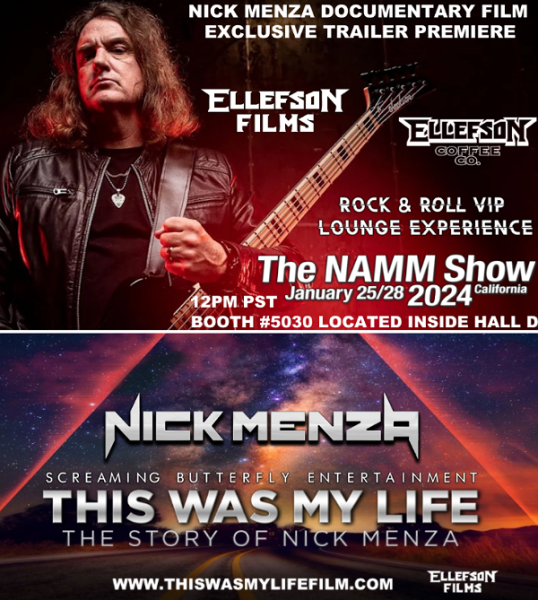
For many fans, Nick Menza exists in a specific frame of reference — a defining era, a powerful presence behind the kit, a sound permanently etched into the catalog of Megadeth. It’s an image shaped by records, tours, and the permanence of recorded history.
But memory, as bassist David Ellefson reflects, is rarely that narrow.
In a written interview conducted in connection with the premiere of the Nick Menza documentary trailer at NAMM, Ellefson spoke less about career highlights and more about the quieter, less visible parts of Menza’s life — the moments that don’t always survive the retelling.
Beyond the Version We Think We Know
While Menza’s musicianship is often discussed in terms of speed, precision, and impact, Ellefson believes the documentary’s real strength lies elsewhere — in the way it steps outside the familiar narrative.
“While the public mostly know Nick as the musical icon that he became from his years in Megadeth there is such a fascinating story of his entire life before and after that. I love most the interviews from family, friends and colleagues who really paint the full picture of Nick’s zest for life, his love of creating music & art and his down-home nature of who he was away from the spotlight.”
What emerges is not a revision of history, but an expansion of it — a reminder that even the most recognizable figures carry lives that extend far beyond the moments we remember most vividly.
Objects That Outlast the Moment
That sense of reflection extends into Ellefson’s MEGA Vault, portions of which were on display at NAMM. The collection isn’t presented as a greatest-hits archive, but rather as an accumulation — objects gathered almost instinctively over time.
“There’s quite a bit of stuff we have — from gold records, to stage clothing, posters, stage-basses and so much more,” Ellefson said. “I’ve tried to keep most of these things from over the years and I think for fans these are fun little behind-the-scenes momentos from my career.”
Stripped of their original context, the items take on a different role. They no longer document success so much as survival — proof that certain moments, once lived, don’t completely disappear.
A Different Kind of Endurance
Away from archival projects and music history, Ellefson’s work with Ellefson Coffee Co. reflects a quieter continuity. Unlike ventures built on novelty, the brand grew out of routine — something steady enough to persist even when touring and public life slowed.
“Well, for me coffee is part of my day to day lifestyle and has been with me on the entire journey so it seemed authentic to have this as my drink of choice,” he explained.
The pandemic tested that endurance, particularly in physical retail spaces, but the shift toward direct-to-consumer sales ultimately kept the brand moving forward.
“COVID affected brick & mortar sales for most all of us,” Ellefson said, “but fortunately we launched online and have used that as our primary sales portal to ship around the world.”
Letting Meaning Accumulate
Asked about his many creative and entrepreneurial pursuits, Ellefson doesn’t describe a master plan. Instead, he speaks in terms of accumulation — of experiences layered over time.
“I just let life unfold and I love being connected to people and experiences which are all part of my life’s story,” he shared. “For me that’s what makes this part of the entrepreneurial journey organic and exciting.”
It’s a sentiment that resonates strongly with the themes surrounding the Menza documentary: that legacy isn’t constructed all at once, and it isn’t always visible while it’s happening. Often, it only becomes clear in retrospect — when the noise fades and what remains is connection.
Interview note: The responses above are presented verbatim from a written email interview with David Ellefson, conducted in conjunction with the Nick Menza documentary trailer premiere at NAMM.